
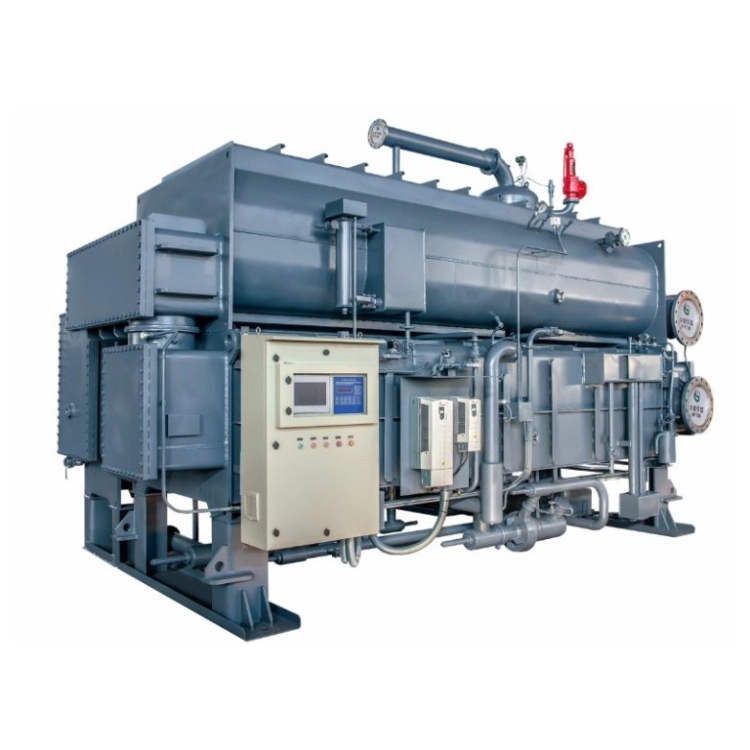
The water pipes of an absorption chiller carry water between separate circuits and the heat exchangers in the machine.
Pipe connections
The pipe connections are generally flanged with a gasket between the two flange faces.
Take care when tightening flange bolts not to strain the pipework or the machine connection branch. The pipework and its fittings must be well supported and aligned so that they do not impose any strain on the machine connections.
The flange jointing material must be suitable for the type of water used (fresh water/glycol) and the water temperature employed.
It must be adequately supported and be able to accommodate thermal expansion and contraction.
To prevent the buildup of scale and other deposits, and to prevent corrosion, pipework should be internally clean and free from swarf or other debris before it is connected to the machine. Where appropriate, strainers should be installed to protect the machine from debris.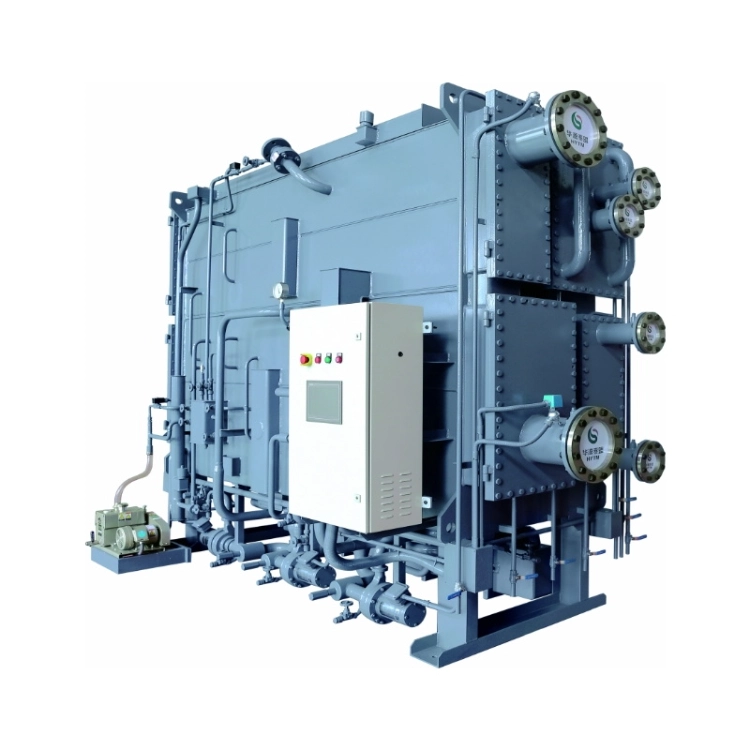
Temporary bypass
For the unit described in the MOON-TECH product notes, cleaning and rust removal take place through a bypass before the pipes are connected to the unit. Wash water must not pass through the unit.
After the pipe installation has been completed, the water pipes connected to the machine must be pressure-tested. Under no account must a higher pressure be applied to the pipe connections than that specified for the absorption chiller.
During testing, care must be taken to eliminate water hammer. Water hammer can cause high local pressure peaks.
Before any pipework is finally connected, check that the pipe systems have been thoroughly cleaned and flushed.
Remove any rust, foreign bodies, or organic matter, to prevent possible fouling of heat exchanger tubes. Debris allowed to enter the absorber, condenser, and evaporator could lead to malfunction or mechanical damage.
Strainers
Strainers should be installed for system cleanliness in the cooling water circuit, chilled-water circuit, and hot-water circuit.
The strainer screens must be cleaned at regular intervals.
The direction of flow through a strainer is indicated by an arrow on the casing. Correct flow direction is a basic requirement.
Gauges and thermometers
The MOON-TECH product notes place thermometers and pressure gauges near the water inlets and outlets.
Vents and drains
Vents at the highest points of the pipework and drains at the lowest points are usually provided for venting and draining of the water circuits during commissioning and maintenance.
The vent and drain connections may be fitted with valves, screw caps, or plugs.
Any air pockets can cause operating problems.
Water treatment
The MOON-TECH notes call for water treatment when water quality is poor, to address scale and corrosion of the heat transfer tubes.
Untreated water or water that is not properly treated can cause corrosion, scaling, and general fouling.
Drawing revisions
All changes to drawings must be recorded.
Revisions must be numbered consecutively.
Revising an existing drawing must not obscure or remove the original design data or dimensions.
The date of the revision and the signature of the person responsible must be entered on the drawing.
Initial filling
Initial filling of the water circuit with water should be done slowly.
During filling, vents must be kept open, or the water circuit must be vented in some other appropriate way. After filling, the vents must be closed.
If the water circuit is not vented correctly, air pockets may cause operating problems.
Check the water circuit and the pipework for leaks.
If the water circuit leaks, it must be repaired before the absorption chiller is commissioned.
The strainers must be checked after filling, and cleaned if necessary.
The cooling water circuit and chilled-water circuit are not necessarily filled at the same time, as they are separate circuits.
Instrument records
All instruments and control equipment must be installed according to the instructions supplied by the manufacturer. They should be inspected at regular intervals to ensure that they function correctly and reliably.
Records of pressure, temperature, and liquid levels should be maintained. Such records can be important aids in assessing the condition of the plant and in predicting potential problems. Records should include log sheets and data for the measuring instruments used.
Flow records
Logs of flow rates and temperatures will enable trends to be identified.
Log should include flow rates and input/output temperatures for all circuits.
Logs of this data would typically be recorded on a daily basis and reviewed to determine if any significant deterioration in performance of the unit is occurring.
The date and any remedial action should also be recorded.
Outstanding work
Make a complete record of the pipe connections to the absorption machine and of all the valves, strainers, gauges, and thermometers that were fitted to the pipework.
The record should include the type and size of the pipes, the material of construction, the location of all valves, and the positions of the vents and drains.
The records should be updated whenever the pipework is modified.
Confirm that the strainers are clean and correctly installed, that the vents and drains are operational, and that the pipework is properly supported.
Check that the water quality is suitable and that, if necessary, scale and corrosion treatment has been applied.
Valve identification
There are many valves fitted in the water pipework of an absorption chiller. The valves must be correctly identified, and their functions must be clear to operators.
The valve chart can be published with symbols and flow diagrams. The valve chart can be presented to the operators and used as a guide for system operation.
The valve chart should be available in the operating room or other accessible location. The chart should be updated whenever changes are made to the valve arrangement.
The chart should show the position (open or closed) in which a valve must be for normal operation and for each mode of operation.
The valve labels can be numbered or otherwise uniquely identified. In most installations, identification is by a tag attached to the valve.
The tag labels should be durable and suitably fixed. The details on each tag should be clear and easily readable. In some installations, color coding is used to distinguish between circuits (e.g., chilled water, cooling water, hot water).