
Pendinginan suhu rendah bukan hanya tentang membuat ruangan dingin. Anda juga harus memikirkan keselamatan staf, keamanan pangan, jam operasional yang panjang, biaya energi, kebijakan refrigeran, dan ekspansi di masa depan. Untuk penyimpanan dingin, pembekuan cepat, pengolahan makanan laut, makanan siap saji, dan pabrik minuman, pertanyaan sulitnya sederhana: bagaimana Anda bisa mendapatkan pendinginan yang optimal tanpa memenuhi seluruh pabrik dengan sejumlah besar amonia? Artikel ini menjelaskan bagaimana sistem pendinginan kaskade NH₃ CO₂ menangani keseimbangan tersebut, dan apa yang harus Anda periksa sebelum memilihnya.
Mengapa Pabrik Makanan Memilih Sistem Pendinginan Berjenjang NH₃ CO₂?
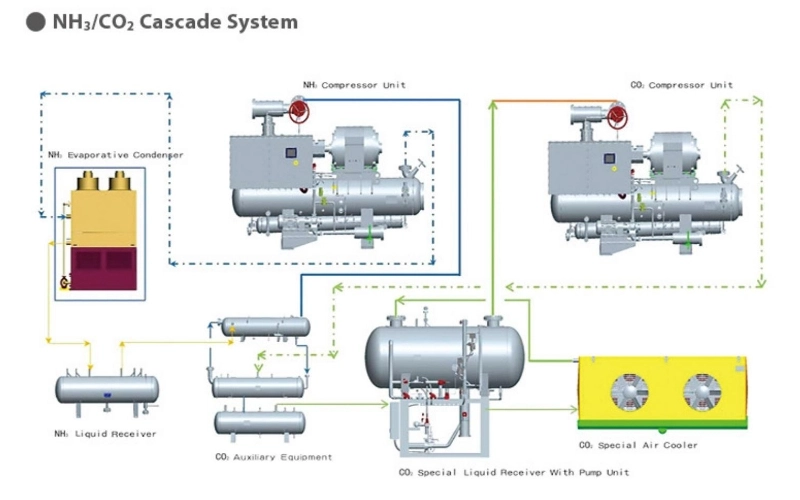
Sistem kaskade menggunakan dua refrigeran di zona suhu yang berbeda. NH₃ terutama bekerja di sisi suhu tinggi, sementara CO₂ membawa pendinginan suhu rendah ke area produksi atau penyimpanan. Pemisahan ini adalah alasan utama mengapa sistem ini dapat menyeimbangkan keamanan dan efisiensi dengan lebih baik daripada banyak tata letak lama.
Keselamatan Dimulai dari Tempat Penggunaan NH₃
NH₃ efisien, tetapi banyak pembeli khawatir tentang volume pengisian dan risiko lokasi. Dalam sistem kaskade NH₃-CO₂, NH₃ tetap berada di bagian suhu tinggi dan tidak perlu dialirkan melalui setiap ruang pendingin, area pemrosesan, atau zona logistik. CO₂ mengambil alih di sisi suhu rendah.
Hal itu penting dalam operasi sehari-hari. CO₂ tidak beracun dan tidak mudah terbakar, sehingga lebih ramah untuk ruang-ruang yang dekat dengan makanan, pekerja, dan area pemuatan. Sistem ini juga dapat mengurangi muatan NH₃ sekitar 70%. Dalam desain muatan ultra-rendah, muatan NH₃ dapat dikurangi hingga 35 kg per 100 kW pada suhu -30°C, dan proyek penyimpanan dingin 10.000 ton mungkin hanya menggunakan 140 kg NH₃. Angka-angka tersebut bukanlah detail kecil. Angka-angka tersebut mengubah bagaimana tinjauan keselamatan, tata letak pabrik, dan perencanaan darurat dirasakan di lapangan.
CO₂ Membawa Pendinginan di Tempat Orang Bekerja
CO₂ memiliki perpindahan panas dan sifat fluida yang baik pada suhu rendah. Ia dapat memindahkan energi dingin dengan volume sirkulasi yang lebih kecil dan hambatan aliran yang lebih rendah daripada banyak fluida sekunder tradisional. Sederhananya, dibutuhkan lebih sedikit upaya pemompaan, dan energi dingin mencapai sisi beban secara lebih langsung.
Bagi pembeli yang membandingkan berbagai jenis sistem, CO₂ Solusi Sistem Pendinginan Ini bukan hanya soal pilihan refrigeran. Ini adalah rencana sistem untuk pengendalian tekanan, pertukaran panas, pasokan cairan, pencocokan kompresor, kontrol otomatis, dan perlindungan keselamatan.
Bagaimana Sistem Cascade Meningkatkan Efisiensi Suhu Rendah?
Kinerja pada suhu rendah adalah saat sistem yang tidak efisien menunjukkan kelemahannya. Semakin rendah suhu penguapan, semakin keras kompresor bekerja. Kesalahan desain kecil dapat menyebabkan tagihan listrik yang besar di kemudian hari, terutama di pabrik yang beroperasi setiap hari.
CO₂ berfungsi dengan baik pada suhu -52°C hingga 0°C.
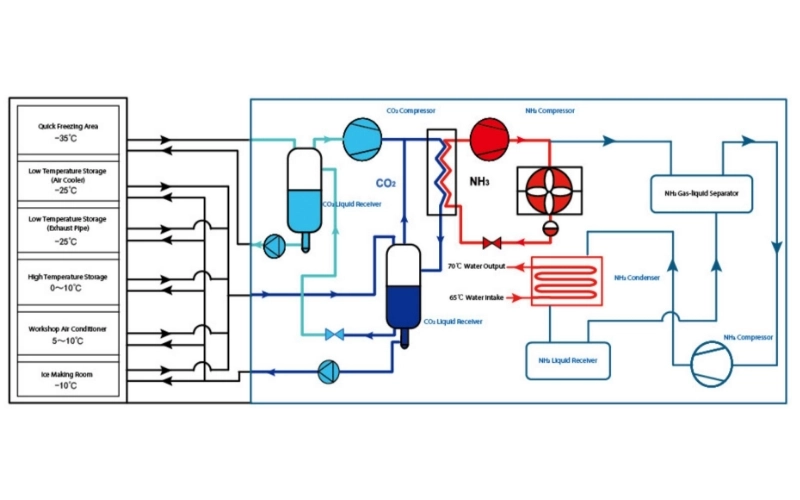
Untuk suhu penguapan dari -52°C hingga 0°C, sistem pendinginan kaskade NH₃ CO₂ sangat cocok. Sistem ini dapat mencakup pembekuan cepat sekitar -30°C, penyimpanan suhu rendah sekitar -25°C, pembuatan es sekitar -10°C, dan penyimpanan suhu lebih tinggi mendekati 0°C.
Rentang yang luas ini sangat membantu ketika pabrik Anda memiliki kebutuhan yang beragam. Pabrik pengolahan makanan laut mungkin membutuhkan pembekuan dalam, penyimpanan beku, dan pendinginan ruang pengemasan. Pabrik makanan siap saji mungkin membutuhkan pembekuan cepat untuk produk yang dimasak dan ruang pendingin untuk bahan baku. Satu keluarga sistem dapat mendukung beban yang berbeda, tetapi desainnya tetap harus dilakukan dengan cermat. Gambar-gambar teknis sangat penting di sini, mungkin lebih penting daripada brosur produk.
Koefisien Kinerja (COP) yang Lebih Baik Sangat Penting dalam Kondisi Pembekuan Ekstrem
Pada kondisi operasi -45°C, COP dari sistem kaskade dapat 8,8% lebih tinggi daripada sistem dua tahap tradisional. Perbedaan itu mungkin tidak terdengar besar pada awalnya. Namun, untuk lokasi rantai dingin yang beroperasi 24 jam sehari, itu bisa berarti penghematan biaya yang signifikan.
Alasannya terkait dengan bagaimana kedua refrigeran tersebut berbagi tugas. NH₃ menangani sisi kompresi suhu tinggi dengan efisiensi yang tinggi. CO₂ menangani sisi suhu rendah dengan perpindahan panas dan perilaku aliran yang baik. Ketika penukar panas antara kedua sisi berukuran tepat, sistem tidak akan membuang banyak energi untuk mengatasi perbedaan suhu.
Detail Peralatan Apa yang Harus Anda Periksa?
Sistem yang aman dan efisien juga bergantung pada komponen-komponen kecil: peringkat tekanan kompresor, luas penukar panas, mode pasokan cairan, manajemen oli, kontrol, dan perlindungan tekanan. Jika poin-poin ini kurang jelas selama penawaran harga, tanyakan lagi. Harga peralatan yang lebih rendah dapat menjadi masalah perawatan setelah musim sibuk pertama.
Sistem pendinginan bertingkat dari -52°C hingga -25°C
Untuk beban pembekuan dalam dari -52°C hingga -25°C, sistem dapat menggunakan unit kompresor sekrup CO₂ dengan resistansi tekanan 4,0 MPa dan desain semi-hermetik. Salah satu konfigurasi yang dirujuk menggunakan model BF16RⅡ dengan kapasitas pendinginan 711 kW.
Evaporator kondensor adalah bagian penting lainnya. Perbedaan suhu pertukaran panas 5°C dan area pertukaran panas 380 m² dapat membantu sistem mentransfer panas antara NH₃ dan CO₂ dengan lebih stabil. Penukar panas yang terlalu kecil mungkin tampak baik di atas kertas, tetapi dapat meningkatkan beban kompresor dan merusak stabilitas keluaran.
Pendinginan Berbasis Refrigeran dari -25°C hingga 0°C
Untuk pusat logistik rantai dingin, pengolahan minuman, dan penyimpanan suhu menengah-rendah, sistem pendinginan berbasis refrigeran dari -25°C hingga 0°C mungkin sudah cukup. Unit modular dapat mengintegrasikan kompresor NH₃ dan pompa pelindung CO₂, dengan suhu keluaran -10°C dan ukuran yang ringkas sekitar 3,7 m x 2,7 m.
Kontrol frekuensi variabel dapat menjaga akurasi suhu sekitar ±1°C dan mendukung pemantauan jarak jauh. Ini berguna ketika beban berubah selama penerimaan, penyortiran, pencairan, atau operasi malam hari. Anda juga dapat meninjau fitur-fitur lainnya. Solusi rentang ketika sumber dingin Anda harus terhubung dengan ruang pembeku, penyimpanan dingin, jalur pemrosesan, dan pemulihan panas.
Di mana letaknya dalam praktik rantai dingin yang sebenarnya?
Sistem terbaik bukanlah sistem dengan daftar fitur terpanjang. Sistem terbaik adalah sistem yang sesuai dengan produk, proses, jadwal ruangan, dan peraturan keselamatan Anda. Sistem kaskade NH₃CO₂ kini digunakan dalam pengolahan daging, produk perairan, minuman, makanan olahan, pengolahan buah dan sayuran, pembuatan es industri, logistik rantai dingin, dan pendinginan proses.
Pengolahan Makanan dan Pembekuan Cepat
Dalam sebuah studi kasus pengolahan makanan, lini produksi menggunakan freezer spiral dengan kapasitas 2.000 kg per jam, dan waktu pembekuan nugget ayam dijaga dalam waktu 25 menit. Kasus seperti itu menunjukkan mengapa desain pendinginan dan peralatan pembekuan tidak dapat dipisahkan. Jika sumber dingin tidak stabil, freezer tidak dapat mempertahankan suhu keluaran yang diharapkan.
Freezer pelat juga membutuhkan pendinginan yang stabil. Desain pelat aluminium 12 lapis dapat memuat makanan laut, daging, atau makanan olahan yang dikemas rata ketika pembekuan kontak lebih disukai. Bagi Anda, intinya bukan hanya model freezer. Yang terpenting adalah apakah sisi CO₂ dapat menyediakan pendinginan suhu rendah yang cukup selama beban puncak.
Logistik, Minuman, dan Pembuatan Es
Logistik rantai dingin membutuhkan ruangan yang stabil, pendinginan cepat setelah pintu dibuka, dan perawatan yang sederhana. Pabrik minuman mungkin lebih memperhatikan stabilitas proses dan beban suhu menengah. Pembuatan es industri membutuhkan pembuangan panas yang kuat dan waktu operasi yang andal.
Sistem kaskade NH₃-CO₂ dapat memenuhi berbagai kebutuhan ini karena CO₂ bekerja dengan baik dalam sirkulasi suhu rendah, sementara NH₃ tetap berada di area yang lebih terkontrol. Ini bukan sihir. Ini hanyalah pembagian peran yang lebih baik.
Bagaimana Sebaiknya Anda Merencanakan Sebelum Membeli?
Sebelum memilih sistem, kumpulkan data proyek yang sebenarnya. Target suhu ruangan, suhu masuk produk, tonase harian, pola pembukaan pintu, waktu pembekuan, volume penyimpanan, kode keselamatan setempat, dan harga energi semuanya penting. Menebak dengan kapasitas kasar berisiko.
Jangan membeli hanya berdasarkan kapasitas nominal saja.
Mintalah perhitungan beban berdasarkan proses Anda, bukan hanya tabel kapasitas standar. Sistem untuk pabrik makanan laut tidak sama dengan sistem untuk gudang minuman. Lokasi dengan pemuatan produk yang sering membutuhkan rencana pengendalian yang berbeda dari lokasi penyimpanan jangka panjang yang stabil.
Untuk perencanaan tahap awal, konsultasi proses lengkap Dapat membantu Anda memeriksa jalur sistem, pemilihan peralatan, ruang instalasi, dan biaya operasional selanjutnya sebelum keputusan pembelian utama dibuat.
Masa Pakai Layanan dan Sistem Itu Penting
Sistem pendingin kaskade memiliki kompresor, penukar panas, bejana, pompa, kontrol, dan perangkat keselamatan. Sistem ini membutuhkan instalasi, pengoperasian, pelatihan staf, dan perawatan yang tepat. Kesalahan kecil pada kontrol dapat membuat operator kehilangan kepercayaan pada keseluruhan sistem.
Teknologi Bulan menyediakan perencanaan proyek, konsultasi teknis, desain teknik, peralatan lengkap, instalasi dan pengoperasian, pelatihan staf, pemeliharaan sistem, diagnosis dan peningkatan sistem, serta manajemen energi kontrak melalui Layanan dukungan. Jika proyek Anda melibatkan beberapa zona suhu atau perluasan di masa mendatang, gunakan kontak Halaman ini digunakan untuk membagikan data kerja utama sebelum model final ditetapkan.
FAQ (Pertanyaan umum)
Q1: Mengapa sistem kaskade NH₃ CO₂ meningkatkan keselamatan?
A: NH₃ sebagian besar disimpan di bagian suhu tinggi dengan volume muatan yang jauh lebih rendah, sedangkan CO₂ berfungsi di sisi suhu rendah. CO₂ tidak beracun dan tidak mudah terbakar, sehingga lebih aman untuk area makanan dan zona akses pekerja.
Q2: Sistem ini dapat mencakup rentang suhu berapa saja?
A: Alat ini dapat mendukung suhu penguapan dari -52°C hingga 0°C, termasuk pembekuan cepat, penyimpanan suhu rendah, penyimpanan suhu menengah, pembuatan es, dan beberapa kebutuhan pendinginan pengolahan makanan.
Q3: Apakah CO₂ lebih baik daripada fluida sekunder tradisional?
A: CO₂ memiliki perpindahan panas yang kuat, viskositas yang lebih rendah, dan volume sirkulasi yang lebih kecil. Hal ini dapat mengurangi penggunaan energi pompa dan membantu menjaga kinerja suhu rendah tetap stabil.
Q4: Apa manfaat energi yang dapat diberikan oleh sistem kaskade?
A: Pada kondisi kerja -45°C, sistem kaskade dapat mencapai COP sekitar 8,8% lebih tinggi daripada sistem dua tahap tradisional. Untuk pabrik yang beroperasi setiap hari, hal itu dapat menurunkan biaya listrik jangka panjang.
Q5: Apa yang harus Anda berikan sebelum meminta penawaran sistem?
A: Anda harus memberikan suhu ruangan target, jenis produk, beban harian, suhu masuk, waktu pembekuan, volume penyimpanan, tata letak lokasi, kondisi daya, dan persyaratan keselamatan. Data masukan yang lebih baik akan menghasilkan desain sistem yang lebih praktis.