
One flow number is a poor description of BOG duty. Tank heat leak creates a base load, then filling, withdrawal and pressure-control actions move it around. Changes in the cold section show up as well. The gas arriving at the package may be much colder than the machinery around it. Put that moving range in the specification.
Routine BOG has moved back onto the agenda for LNG terminals and small liquefaction jobs. The pressure number is easy to spot on a data sheet. What happens when the load drops or jumps is less obvious, and that is where heater duty, buffer capacity, liquid protection, the oil circuit, after-cooling and the final gas route start to matter.
On its حلول تطوير حقول النفط والغاز page, MOON-TECH puts compression in the same route as cooling, liquefaction, storage and transportation. That is a sensible way to read a small-scale LNG RFQ too: follow the gas through the plant, not just across the compressor skid.
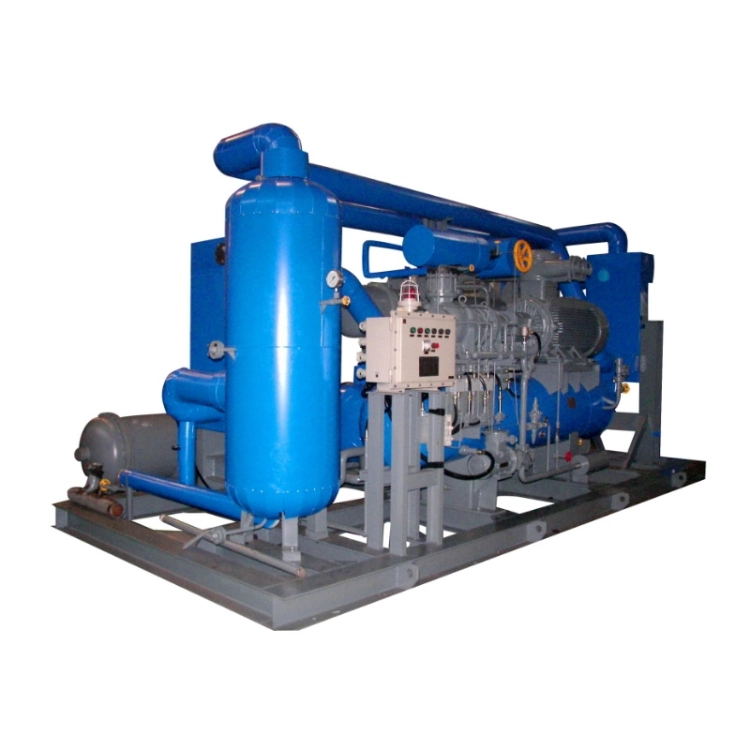
Start With the BOG Envelope
Start with two plain questions: where does the gas come from, and where is it going? In MOON-TECH’s process description, tank BOG can go to combustion, a pipeline route or back toward the cold box for re-liquefaction. Each route wants a different discharge condition. If the plant keeps more than one option, its control note must name the first choice.
Composition belongs at the top of the data sheet. Include methane and heavier components, nitrogen, any known impurities and the chance of air ingress during maintenance or low-pressure operation. Then give inlet pressure, inlet temperature and flow as ranges. A short peak during filling is not the same as a continuous normal load. Both may affect the selection.
مون-تك BOG Compressor product information lists an inlet pressure range of 0 to 0.5 MPa(G), an outlet pressure range of 0.5 to 4.5 MPa(G), inlet temperature above -50°C and outlet temperature below 50°C when ambient temperature is at or below 40°C. The listed flow-regulation range is 10% to 100%. These are product information limits, not a replacement for a project operating map.
Protect the Compressor Inlet
BOG Heater
Very cold gas may need heating before it reaches the compressor package. The heater duty has to be based on the lowest inlet temperature, gas composition, expected flow and the required compressor suction condition. It should also be checked at low flow. A heater sized only for the maximum case may not control well when the plant is quiet.
Buffer Tank and Liquid Protection
When BOG flow jumps, a buffer tank buys the pressure controller some time and may help separate liquid. It is not a cure for two-phase flow from the tank area. Check the upstream line slope, level detection, drains and shutdown action. What reaches the compressor should still be gas in the agreed suction condition.
Inlet Filtration
Filtration appears ahead of the compressor in MOON-TECH’s sequence. Put the target solids, clean and dirty pressure drop and element-removal space in the RFQ. Routine element change should not require nearby pipework to be dismantled.
Review the Full Compression Train
إن MOON-TECH flow starts with the heater, buffer tank and inlet filter, followed by Stage I and Stage II. From there, process gas passes the oil separator and final oil eliminator before the after-cooler. The oil circuit is separate: cooler, filter, pump, and back to Stage I.
Check this train at the low and high flow cases. The review should capture stage pressure, outlet gas cleanliness, the site’s real cooling medium and ambient basis, plus a destination for every drain.
Capacity is listed as slide-valve regulation, with variable frequency and slide-valve adjustment available in combination. Ask the bidder to plot that control range. The plot should identify minimum stable operation and the response to a fast tank-pressure rise.
Do Not Put BOG and MR Duty on One Data Sheet
An early equipment list sometimes puts the BOG and MR compressors on a single line. Break them apart. One machine deals with evaporated LNG process gas. The other keeps the refrigerant moving around the cooling and liquefaction circuit. They don’t belong on the same data sheet.
Binglun gives four applications for the MR unit: small-scale LNG production, light hydrocarbon recovery, BOG treatment and helium recovery. In the main circuit, low-pressure mixed refrigerant leaves the cold box, is compressed, has oil removed and is cooled, then heads back to the cold box. Pre-cooling is a separate propane circuit using R290; on the return side, the propane is liquid.
Keep two data sheets and tie them together with one interface note. Cold-box pressure, temperature limits, trips, start-up sequence and cooling utilities all sit in that note. Add the fallback case as well: what can the plant do if one compressor is down?
Controls and Low-Load Operation
The design case may be maximum flow, although day-to-day operation often sits lower. Describe control at low flow and during a fast tank-pressure rise. Then cover high discharge temperature, heater failure, detected liquid, oil alarms and an after-cooler trip. Any recycle or alternate gas route needs a stated limit and owner.
Request the alarm and trip list before design freeze. Its tags should tell the operator whether the event started at the tank, heater, inlet separator, compressor, oil system or receiving process. One common compressor alarm cannot provide that trail.
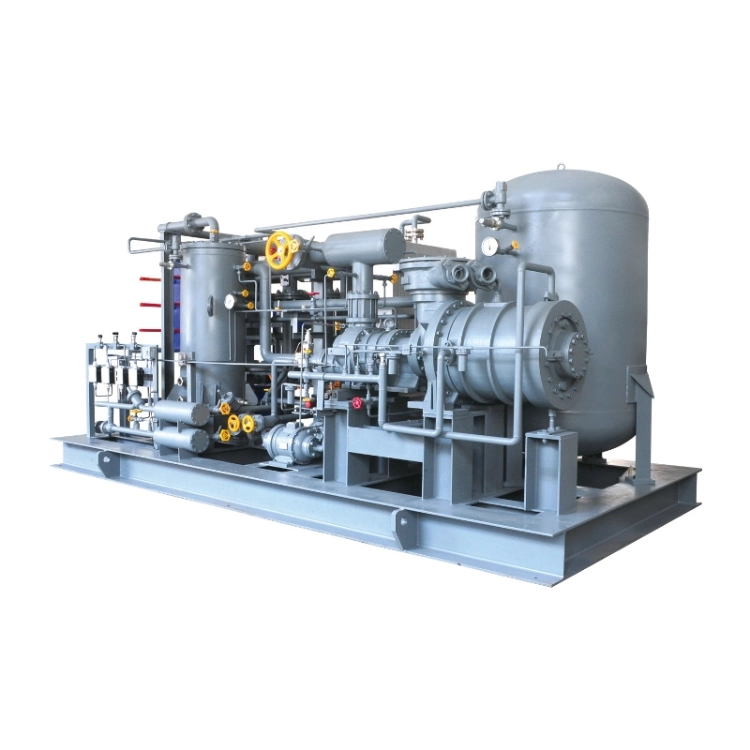
A Practical BOG Compressor RFQ Checklist
- Gas source, full composition and expected contaminants.
- Minimum, normal, maximum and short-duration peak flow.
- Inlet pressure and temperature for all operating modes.
- Required outlet pressure, temperature and destination for each gas route.
- Heater duty, heating medium and low-flow control requirement.
- Buffer volume, liquid separation, drains and shutdown signals.
- Compression stages, capacity-control method and minimum stable operation.
- Oil separation requirement and downstream gas-cleanliness target.
- After-cooler medium, design ambient and permitted pressure drop.
- Site information: power supply, hazardous-area classification, noise limit, skid envelope and the working room needed for maintenance.
- Control-system handoff, cause-and-effect chart, plus the agreed order for starting the package and the plant.
- A battery-limit drawing that assigns the piping, valves, instruments, relief connections, insulation and utilities to the buyer or the package supplier.
Make every bidder answer the same operating cases. A quotation with one rated point is incomplete, so request the low-load and short peak cases before lining up prices. Otherwise the comparison has no common gas basis.
استنتاج
A BOG Compressor should be selected from the real tank and process envelope, not from one headline flow. Define the gas, protect the inlet, review both compression stages, set oil and after-cooling boundaries, and write the low-load control logic before ordering. MOON-TECH’s BOG Compressor and Mixed Refrigerant Screw Compressor Unit cover different duties within small-scale LNG and gas recovery projects. The final package arrangement still has to match the site’s gas data and downstream route.
أسئلة متكررة
Q1: What happens to BOG after it reaches the compressor?
The gas leaves at the pressure needed by its next destination. Depending on the plant, that can mean a fuel system, pipeline transfer or a return to re-liquefaction.
Q2: Which published BOG Compressor limits should go into the first check?
Use 0 to 0.5 MPa(G) for the published inlet range and 0.5 to 4.5 MPa(G) for the outlet range. The same sheet states an inlet above -50°C, a 10% to 100% regulation range, and an outlet below 50°C when ambient temperature does not exceed 40°C. These are screening limits; the project’s gas analysis and cases still govern selection.
Q3: Why are the heater and buffer tank placed upstream?
The heater lifts a cold BOG stream toward the agreed suction condition. The buffer tank slows pressure changes and may assist liquid separation. Both duties are calculated from the actual gas and tank behavior.
Q4: Are BOG and mixed refrigerant duties interchangeable?
No. BOG is process gas from the LNG system; mixed refrigerant belongs to the cooling circuit. The machines can work in one plant, but their gas data, operating cases and controls remain separate.
Q5: What usually needs a second look before BOG bids are compared?
Low-load running and short peaks are often left vague. The same goes for liquid protection, outlet gas cleanliness, after-cooler conditions and battery limits. Close those points before the bid comparison starts.