
A standard refrigeration package can be a good fit when the cooling load, temperature, and operating schedule are predictable. Industrial plants are often less straightforward. Product temperature changes, seasonal production, limited machine-room space, part-load operation, refrigerant requirements, maintenance access, and future expansion can all affect the final system.
Custom refrigeration starts with those operating conditions instead of forcing the plant around a fixed package. MOON-TECH provides refrigeration equipment and integrated solutions for food processing, cold storage, process cooling, and other industrial applications. For projects considering natural refrigerants and low-temperature operation, its CO₂ Solución de sistema de refrigeración provides a specific system path rather than a general equipment category.
Why Do Industrial Refrigeration Needs Differ?
Two plants with similar cooling capacities may still need very different refrigeration systems. Temperature level is only one part of the decision. Load variation, production rhythm, site layout, airflow, heat rejection, controls, and maintenance conditions matter as well.
Process Temperature Changes the System Design
A frozen-food line may need rapid pull-down and low evaporating temperatures. A chilled logistics warehouse can operate at a higher temperature but experience frequent door openings and changing storage loads. A process cooling system may need stable fluid temperature rather than room-temperature control.
These differences affect compressor selection, heat exchangers, evaporators, piping, defrost strategy, refrigerant choice, and controls.
The design should therefore begin with product inlet temperature, target temperature, process time, room conditions, cooling medium, and production schedule.
Load Patterns Are Rarely Constant
Some plants operate close to a stable load for most of the day. Others have sharp peaks.
A seafood plant may receive large batches that need rapid freezing. A distribution center may operate at relatively low load overnight and see demand rise when loading begins in the morning. A food processing line may stop between shifts while cold storage continues running.
A custom system can account for these differences through compressor staging, variable-frequency control, zoning, redundancy, and part-load operation.
The Site Can Limit Otherwise Good Equipment
Floor area, pipe length, electrical capacity, outdoor temperature, equipment access, ventilation, and maintenance space can change what is practical.
A compressor package may look suitable on a specification sheet but create problems if valves cannot be reached, motors cannot be removed, or filters sit behind other equipment.
This is why refrigeration equipment and machine-room layout should be reviewed together rather than treated as separate purchases.
What Are the Main Benefits of Custom Refrigeration?
Customization does not mean adding complexity for its own sake. The main benefit is better alignment between the refrigeration system and the work the plant actually needs to perform.
Better Equipment Matching
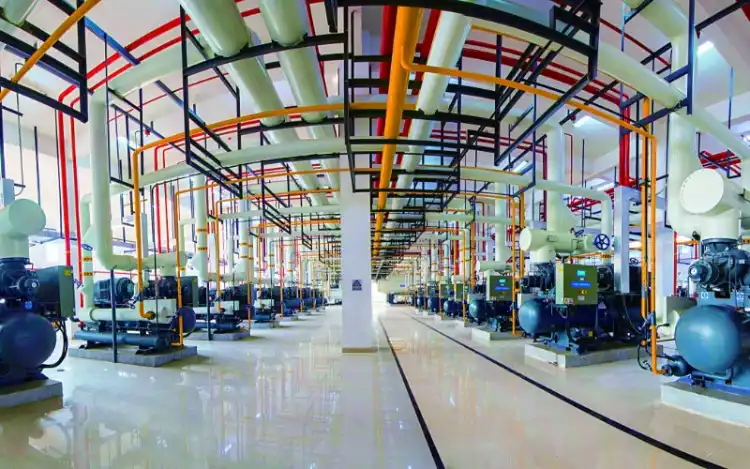
A large refrigeration system may combine compressor units, evaporators, condensers or gas coolers, pumps, vessels, valves, heat exchangers, cold-storage equipment, freezing equipment, and automatic controls.
The components need to work together under peak and partial-load conditions.
MOON-TECH soluciones industriales cover different refrigeration, heating, and industrial thermal applications. Equipment can therefore be selected around the required temperature, process, site conditions, and operating profile instead of being limited to one standard package.
Good matching is especially important at partial load. An oversized system may spend much of the year operating far below its design point. A system selected only for average conditions may struggle when warm products enter the plant or production increases.
More Stable Operation
Stable cooling is not only a question of installed refrigeration capacity.
Air distribution, compressor control, temperature zoning, defrost, sensor placement, valve response, and load changes all influence daily operation.
A custom design can separate different temperature zones and operating demands more logically. For a cold-storage facility, that can mean better control when doors open or product loads change. For process cooling, it can help maintain a more consistent supply temperature during production.
Heat Recovery Can Be Considered Early
Refrigeration systems reject heat while they produce cooling. At some sites, part of that heat can be used elsewhere.
Potential uses include process hot water, cleaning water, space heating, or other thermal loads. Heat pumps may also be considered where useful heating demand exists at the same time as cooling demand.
El toda la cadena industrial approach becomes relevant when refrigeration, heat exchange, heat pumps, and waste-heat use need to be coordinated.
Heat recovery is not automatically suitable for every project. The available heat temperature, operating hours, heating demand, distance between systems, and additional equipment all need to be checked first.
When Does a CO₂ Refrigeration System Make Sense?
CO₂ is not a universal replacement for every industrial refrigerant. Its value depends on the required temperature, system configuration, local climate, operating conditions, safety strategy, and service capability.
MOON-TECH CO₂ Solución de sistema de refrigeración is used across food processing, aquatic products, prepared food, fruit and vegetable processing, dairy, industrial ice making, cold-chain logistics, and process-cooling applications.
Low-Temperature Freezing
Low-temperature freezing is one area where CO₂-based configurations are particularly relevant.
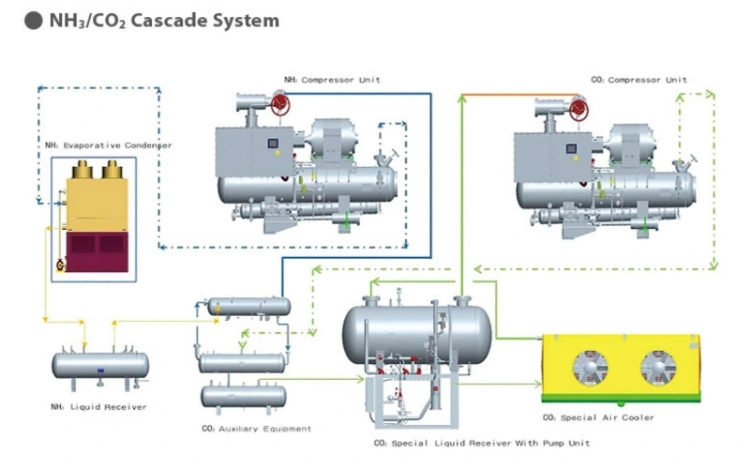
MOON-TECH’s CO₂ solution includes an NH₃/CO₂ cascade refrigeration configuration for approximately -52°C to -25°C, aimed at ultra-low-temperature freezing applications. The configuration can combine CO₂ screw compressor units with condenser-evaporator equipment.
For food plants, this kind of configuration may be considered when rapid freezing, deep-freezing rooms, or low-temperature storage create operating conditions beyond those of a standard chilled warehouse.
The system still needs to be selected around real product conditions. Freezing tuna, poultry, prepared foods, and other products can involve very different product sizes, inlet temperatures, throughput, and required freezing times.
Cold Chain and Food Processing
CO₂ refrigeration also fits projects where cold storage and food processing are closely connected.
A large processing site may have production rooms, quick-freezing equipment, chilled storage, frozen storage, and loading areas working at different temperatures.
In seafood processing, for example, MOON-TECH combines refrigeration engineering with cold storage and quick-freezing equipment. Its seafood processing solutions include applications using NH₃/CO₂ cascade refrigeration in large low-temperature processing projects.
This type of project benefits from looking at the entire refrigeration load instead of selecting the freezer, cold room, and compressor room independently.
Natural Refrigerant Projects
CO₂ can also be considered when a project is moving toward natural refrigerants.
Its use does not remove the need for careful engineering. Pressure conditions, controls, equipment ratings, relief protection, heat rejection, compressor operation, and service procedures all need to suit the selected CO₂ configuration.
The decision should therefore be based on the full operating envelope rather than on refrigerant choice alone.
How Is the CO₂ Refrigeration System Solution Configured?
The main advantage of a concrete CO₂ solution is that it gives buyers actual system options rather than simply telling them that “CO₂ refrigeration is available.”
NH₃/CO₂ Cascade Refrigeration
A cascade system separates the refrigeration duties into different stages.
MOON-TECH’s low-temperature cascade configuration uses CO₂ on the low-temperature side and NH₃ within the broader refrigeration arrangement. The company positions this configuration for ultra-low-temperature applications where very low evaporating temperatures are required.
This approach can be useful in large freezing plants because CO₂ can serve the low-temperature load while the system configuration limits where ammonia is used.
Equipment selection still depends on capacity, temperature, product load, heat rejection, pressure ratings, and redundancy requirements.
CO₂-Based Cooling for Cold Chain Applications
Not every CO₂ project needs the same cascade arrangement.
MOON-TECH also provides a refrigerant-based cooling configuration aimed at cold-chain logistics and related industrial applications. One modular option combines an NH₃ compressor and CO₂ pump within an integrated package, with variable-frequency control and remote-monitoring capability.
For a buyer, the useful question is whether this configuration fits the site’s temperature level, room arrangement, load pattern, and maintenance strategy.
A compact modular system may be attractive where machine-room space is limited, but space alone should not determine the refrigeration architecture.
Compressors, Controls, and System Integration
The compressor should be selected together with the control strategy.
Industrial cooling loads change. A unit selected only around maximum capacity may spend much of its operating life at partial load.
Variable-frequency control, compressor staging, pressure management, temperature sensors, alarm logic, and trend monitoring can help the plant respond to these changes.
The same applies to heat exchangers, pumps, valves, and vessels. A CO₂ system is not one machine. Its performance depends on the way those components operate together.
What Should Buyers Check Before Selecting a CO₂ System?
A concrete solution still needs to be matched to a concrete project. Buyers should be able to see the design assumptions behind the proposed system.
Start With Temperature and Load
Define the required room or process temperature first.
Then check product throughput, inlet temperature, target temperature, operating hours, peak loads, partial-load periods, seasonal ambient conditions, and expected expansion.
A freezing plant processing several tons per hour should not be evaluated in the same way as a cold-storage warehouse holding finished products.
These assumptions affect the refrigeration configuration and the equipment size.
Check Pressure and Safety Design
CO₂ systems operate under pressure conditions that require suitable equipment ratings and protection.
Buyers should ask how pressure limits, relief devices, sensors, control valves, alarms, shutdown logic, and commissioning tests are handled.
If an NH₃/CO₂ cascade system is proposed, the interface between the two refrigerant circuits also needs to be clearly defined.
The goal is not simply to install a natural refrigerant system. It is to install one that the operating team can understand, monitor, and maintain.
Review Access and Future Service
Maintenance access should be checked before the system is installed.
Compressors, pumps, valves, filters, control panels, sensors, vessels, and other service points need practical working space.
MOON-TECH servicio support can cover installation and commissioning, maintenance, technical consultation, diagnosis, training, and system upgrades.
For projects that need earlier engineering discussion, consulta de proceso completo can also be used to review operating requirements and equipment selection before the final configuration is fixed.
Where Can a Custom CO₂ Refrigeration Solution Be Applied?
The best applications are usually those where refrigeration is a direct part of production, freezing, or cold-chain operation.
Food Freezing and Processing
Food plants may combine quick freezing, chilled processing rooms, frozen storage, and cold storage in the same facility.
Product throughput and inlet temperature can change from one shift to another. Freezing equipment may run heavily while storage loads remain relatively stable.
A custom CO₂ solution can be designed around these different loads rather than forcing every part of the plant to follow the same operating pattern.
Large food-processing projects have also used cascade arrangements combining CO₂ and R717 units together with secondary refrigeration loops and quick-freezing equipment.
Cold Chain Logistics
A logistics center has a different operating profile.
Cold rooms may spend long periods at stable conditions, then experience large load changes when trucks arrive, doors open, and warmer products enter storage.
MOON-TECH cold-chain logistics solutions combine refrigeration systems with cold-storage planning, equipment supply, installation, commissioning, and warehousing requirements. The company also identifies CO₂ as an option for low-temperature cold-storage applications.
Industrial Process Cooling
CO₂ refrigeration can also be considered for selected industrial process-cooling applications.
Here, the decision may depend less on storage temperature and more on required process temperature, load stability, fluid conditions, safety requirements, and operating continuity.
Projects with unusual temperature or process conditions should be reviewed using the actual load, flow rate, operating schedule, and site conditions. Buyers can use the Página de contacto de MOON-TECH when a project requires a configuration based on specific operating data.
Conclusión
The main benefit of custom industrial refrigeration is not added complexity. It is a better match between the refrigeration system and the plant.
Temperature level, load pattern, product throughput, site layout, refrigerant choice, part-load operation, safety, maintenance, and expansion plans all affect the final design.
For projects where natural refrigerants and low-temperature cooling are relevant, MOON-TECH’s CO₂ Solución de sistema de refrigeración provides a specific technical route. It can include NH₃/CO₂ cascade refrigeration, CO₂-based cooling configurations, compressor units, heat-exchange equipment, pumps, controls, and system monitoring according to the project conditions.
The key is to choose the configuration around the real process rather than treating CO₂ as a one-size-fits-all refrigerant.
Preguntas frecuentes
When Should an Industrial Plant Consider a CO₂ Refrigeration System?
A CO₂ system can be considered when the project involves low-temperature freezing, cold-chain logistics, food processing, natural-refrigerant requirements, or other operating conditions suited to a CO₂-based configuration.
What Is an NH₃/CO₂ Cascade Refrigeration System?
It uses separate refrigeration stages with NH₃ and CO₂ performing different functions within the system. MOON-TECH’s cascade configuration is intended for low-temperature applications where CO₂ serves the low-temperature refrigeration side.
Can CO₂ Refrigeration Be Used for Food Freezing?
Yes. CO₂-based systems can be applied to food processing, seafood freezing, quick-freezing facilities, and low-temperature cold storage when the system is designed for the required temperature and load.
Is CO₂ Refrigeration Suitable for Every Industrial Project?
No. Refrigerant choice should consider temperature requirements, climate, system pressure, safety design, heat rejection, service capability, load pattern, and project economics.
What Should Buyers Provide Before Requesting a CO₂ Refrigeration Solution?
Provide the required temperatures, product or process load, throughput, operating schedule, site conditions, available utilities, ambient conditions, space limitations, redundancy requirements, and expected future expansion.