
Plate-freezer quotations often arrive looking finished: model, plates, power, kilograms per shift. Fine. Then production day one runs late. When I go back through the inquiry, the reason is usually sitting there in plain view—a thicker seafood block, a bowed carton, uneven trays, or a loading time nobody put on the sheet.
I don’t accept a bare cycle time for seafood. Which block? Which pack? How warm at the door, and where must the centre finish? Without those four notes the number has no real home. Change one, and the minutes move.
MOON-TECH lists its current plate quick freezer range with model data and a stated reference basis. That reference is useful, but it is not a shortcut around the product details.
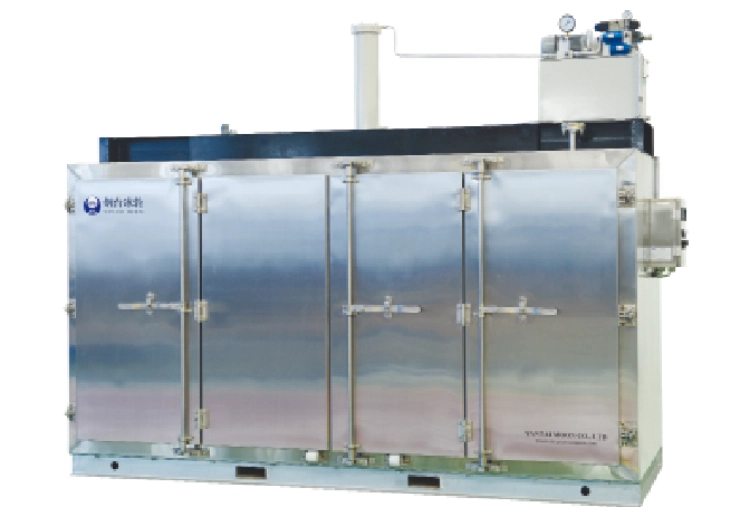
First job: measure the block that’s really going in
My first request is the block as it reaches the freezer, not the mould drawing. Length and width, yes, but thickness needs a range. If an ’80 mm’ tray keeps coming off the line at 88 mm, I write down 88. The probe goes to the centre, so those extra millimetres are part of the job.
The pack sits in the heat path, which is easy to forget. A flat tray meeting the plate squarely is straightforward. A corrugated box with a bubble of air, a folded liner, or a domed top isn’t. Cold has to cross that contact face. Gaps get in the way, and leaning harder on a misshapen carton isn’t a proper fix.
MOON-TECH’s MPF description is quite literal: product between several plates, hydraulic opening for handling, plates pressed down for the freeze. Double-sided contact. Once you picture the movement, the need to match pack thickness with plate spacing is obvious.
What the capacity note actually says
There’s a small but important note under the MPF table: hairtail fish, 600 × 400 × 80 mm trays, 15 kg in each. I copy that note into the comparison sheet. Squid in another tray, oversized cartons, mixed products—those are different cases. The table helps us start the calculation; it doesn’t sign off the shift total.
I work it twice. Batch load comes first: real pack footprint, usable plate area, actual filled weight. Shift output comes later. That second line includes hands-on loading, closing, freezing, opening, release, and the awkward minutes around cleaning or a product swap. Count only the closed-plate time and the spreadsheet will flatter you.
What I put in the RFQ attachment
- Name the seafood and the form—whole, fillet, mince block, cooked block, glaze, or something else.
- Actual package or tray dimensions, filled weight, thickness tolerance and photographs of a normal filled pack.
- Write down loading temperature, the required centre temperature, and exactly where the probe will go.
- Show the batch target and the real shift calendar: hours, planned cycles, changeovers, wash time.
- Add the plant side too—refrigerant, evaporating condition, utilities, room, drains, and a route for lifting parts.
Before debating minutes, freeze a normal batch
Seafood blocks have a habit of ignoring neat averages. So, where the job is sensitive, I prefer one ordinary plant batch: normal fish, normal liner, normal filling crew. Probe the centres most likely to be slow. And time the people at the door; don’t log only the temperature curve.
One good trial also exposes handling problems. Operators may need room to align trays, liners may fold over the edges, or frozen blocks may be harder to release than expected. Those minutes belong in the commercial discussion because they affect output every shift.
When the freezer has to join a larger line, the quick freezer and freeze dryer product group gives the team a quick look at the other freezing routes before the layout is locked.
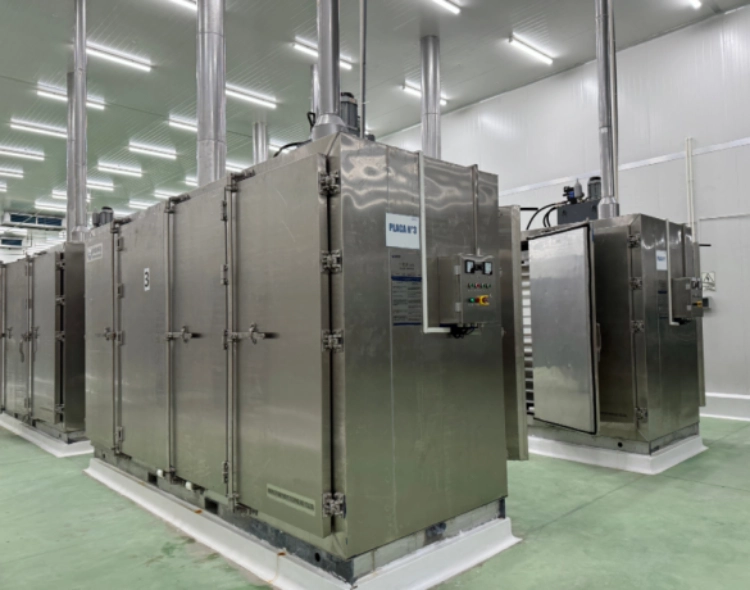
Don’t charge every late minute to the freezer
A late shift doesn’t prove a slow freezer. Maybe blocks queued in forming. Maybe the loading crew was one person down. Maybe half the trays were thick. On the test sheet I keep three clocks: load/open, plates closed, unload/reset. It saves a lot of vague arguments about ‘refrigeration time.’
Core checks need the same honesty. Agree the probe method before the commissioning run. The easy outside block will usually give the nicest reading; that isn’t the point. Take the likely slow positions and repeat the same sampling rule next time.
Now look at the plant around the freezer
A big plant may already have an engine room; it needs the freezer and pipe connections. A small, separate room may suit a packaged approach. MOON-TECH describes MPF-(F)Z as an MPF contact freezer plus its matching compressor-condensing unit on one base. Air-cooled or water-cooled versions are listed. Which one? That still comes back to summer ambient, water, service habits, and the real load.
Freezing is only one stop in a seafood plant. The official seafood solution page is useful for checking how handling and cold storage sit around that stop.
Draw drains, wash access and service clearances before the purchase order. I also mark a future removal route for a plate, hydraulic part, or refrigeration component. Compact is good; boxed-in is not.
Conclusión
My short version: begin with the seafood block and work outward. Real thickness. Real contact face. Batch weight, temperature in, centre target, handling minutes. Only then put the published reference beside it. It’s more homework than asking for tonnes per shift, but the resulting number can survive a production meeting.
For a real project discussion, send the product sheet, pack photos and shift plan through the MOON-TECH website rather than asking for one universal freezing time.
Preguntas frecuentes
What information has the biggest effect on plate-freezer cycle time?
Block thickness, package contact, inlet temperature and the required centre temperature usually deserve the first check. Batch loading and unloading time then decides how that freezing cycle translates into shift output.
Can I use the nominal kg/shift figure for another seafood product?
Use it as a reference only when the stated basis is known. Different species, block thickness, tray, filled weight or starting temperature can change the result.
Why does a carton freeze more slowly even when the weight is the same?
The carton, liner and any air gap sit between the plate and the food. Poorly filled or bowed packages reduce effective contact and make heat travel through a less direct path.
Should acceptance testing include loading time?
Yes, if the purchase discussion is about batch or shift output. Record loading, freezing, unloading and reset separately so both sides can see where time is being used.
When does an integrated MPF-(F)Z arrangement make sense?
It can suit a site that wants the contact freezer and matching refrigeration source on a common base. Final selection still needs ambient, condenser, water, electrical and service-access checks.