
Suppose a factory is throwing away warm water while buying steam on the other side of the fence. There may be a good heat-recovery project hiding in that mismatch. Or there may not. Production records might show that the warm stream disappears just as the heating load rises. A water sample might reveal the solids that the first sketch ignored.
MOON-TECH supplies equipment and engineering for cold processes, useful heat, and process gases. That range matters when one duty affects another. A useful first meeting sounds less like a catalogue review and more like an operator’s account of the day: the troublesome stream, the hour it moves, and the condition needed at the other end.

Start on the Plant Floor
Walk through the plant before drawing a new system. Where does cooling water pick up heat? Which vessel vents warm vapor? Does wastewater run continuously or only after a batch? Now look for a nearby demand. The timing and temperature must make sense on both sides.
The plant data should show normal operation and the awkward hours. Minimum and maximum flow matter. Pull the hottest cooling-water reading from summer and the coldest source-water reading from winter. Add a start-up log and one shift when a unit was unavailable. The nameplate point can then be read in context.
Who supplies field pipe? Who integrates the package with the control room? Is water treatment inside the contract? What must be running during the acceptance test? These are commercial questions with technical consequences. MOON-TECH’s consultation complète is intended to settle the process boundary, utilities, installation work, and commissioning scope before delivery.
Read the Gas Train From Left to Right
Associated gas can leave the well site at a pressure too low for the next step. After boosting, its temperature rises; it then has to be cooled and dried before the cold section. Water carried past that point is no longer a minor upstream issue. Gas composition deserves the same attention. A package chosen from one sample can be a poor match when heavier components or contaminants drift beyond it.
Le Oil and Gas Field Development Solution shows the broader route. A project review then fills in the missing numbers: compressor inlet and outlet conditions, the latest gas analysis, flow at quiet and busy periods, local weather limits, and where the treated gas will go.
Do not combine the gas compressor and the refrigeration package under one vague “compression load.” The gas machine creates the pressure required by the process. On a separate circuit, refrigerant collects the heat that the cold section cannot keep. Common cooling water and linked trips do not erase that difference.
Keep CO₂ Conditions Visible
In the described CO₂ processing configuration, captured CO₂ is cooled before compression. Liquefaction and storage follow. The pressure band shown for compression is 1 to 6 MPa; the liquid end sits around -30°C to -55°C. Treat those values as signposts. Before using them in a specification, check the impurity sheet, promised dispatch grade, loading method, and the receiver’s limit.
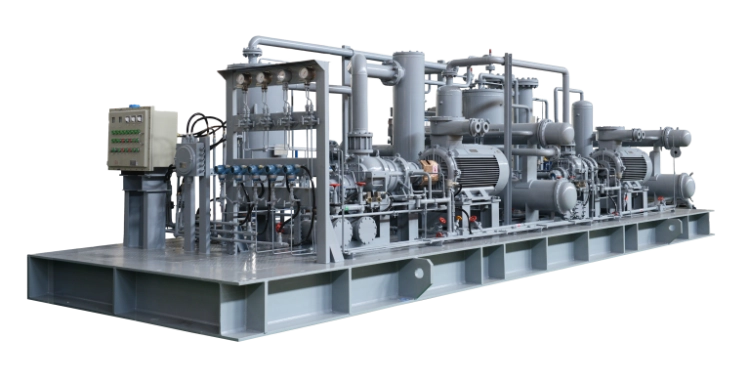
Heat rejected between compression stages also needs a destination. If that duty is missing from the utility review, the system can look satisfactory on paper and struggle during warm-weather operation.
Pair Waste Heat With a Real User
In an industrial-park wastewater heat recovery application, wastewater at 32°C is used to produce hot water at 75°C. The duty is 7 MW. Under the stated conditions, the maximum comprehensive COP reaches 3.4. Read the three figures together. A different factory cannot borrow the result unless its water and hourly demand tell the same story.
A nominal COP can hide the hard part of the job. Ask how the unit performs when the source is coldest and the delivery temperature is highest. Then check part load. Pump power, cleaning access, water treatment, and backup heating can change the operating picture.
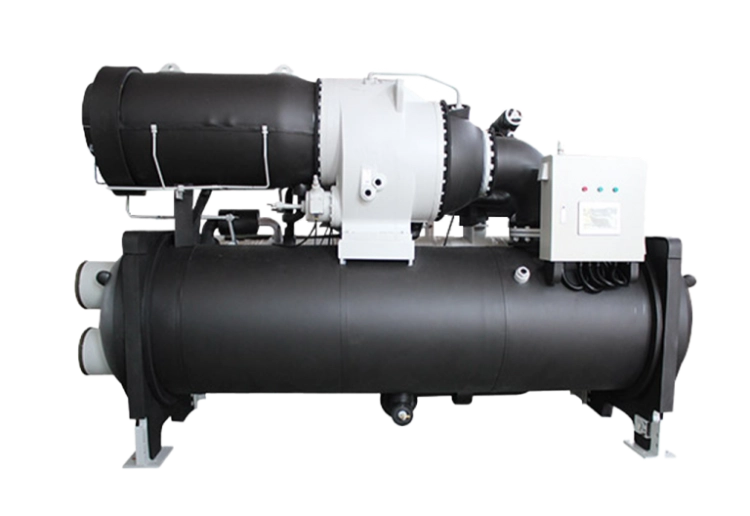
Distillation presents a different match. Vapor leaves the top carrying energy while steam is bought for the reboiler below. A heat pump can bridge those duties. Its compressor, however, has to follow the column balance, not a percentage borrowed from another plant. A useful study also looks at grade changes, low-rate production, and the way the column starts.
When flue gas crosses its condensation point, the job changes. The extra heat arrives with liquid that has to be drained and surfaces that may corrode. Materials and condensate handling therefore sit beside the heat calculation. A warm return-water loop can still limit recovery, whatever temperature appears in the proposal.
Look Beyond the Machine Room
Mass concrete in hydropower and nuclear construction is a useful example. Aggregate cooling, chilled water, ice production, pumps, pipe length, storage, and the pour schedule all add to the load seen at the placement point.
For this concrete cooling application, the specified dynamic ice-slurry concentration is 35%, with supply-water temperatures ranging from 0.5°C to 1°C. Screw chilled-water units in the same material span 600 to 3,000 kW. Sizing begins elsewhere: cubic metres of concrete per hour, the placement target, the day’s weather, batching pace, and heat gained on the route to the pour.
Because the slurry can be pumped, cold can be moved through the site without handling separate pieces of ice. The control screen still has to connect production with delivery. Ice concentration at the plant means little if flow falls, a tank level collapses, or aggregate reaches the pour too warm.
Make Commissioning Useful Next Year
An acceptance sheet is weak if it says only “passed.” Copy the instrument readings, valve positions, package power, and production rate into the record. When someone raises a performance question months later, the comparison will be with a real test rather than a memory.
After handover, a night-shift operator should be able to recover from a trip without inventing a sequence. Each alarm needs a reason, each isolation point a label, and each routine replacement a stock reference. The MOON-TECH service scope runs from design and procurement to installation, commissioning, upgrades, and training. Those handover items can therefore be named in the contract rather than requested at the end.
A short inquiry is enough when it is concrete. Say what the plant makes and describe the stream that is causing trouble. Note its schedule and the utilities already on site. Existing analyses and operating ranges are worth attaching even when a few cells remain blank. The portefeuille de solutions helps identify the relevant route; the page de contact is where the process notes and drawings can be introduced.
FAQ (questions fréquentes)
Q1:Where should an integrated energy project begin?
A1: Begin with the process streams, source and demand temperatures, flow ranges, operating schedule, utilities, and site limits. The equipment choice follows from those conditions.
Q2:When is recovered condenser heat worth using?
A2: It is worth studying when a nearby process calls for heat during the refrigeration run. A mismatch in hours points to storage or backup. The calculation also has to survive the seasonal source temperature and the electricity used by pumps.
Q3:Why does a gas project carry two compressor duties?
A3: Gas flow and required pressure rise govern the process machine. Heat arriving at the cold section governs the refrigerant machine. With separate duties, shared coolers and electrical loads can be checked without mixing unlike work.
Q4:What field readings help with heat-pump sizing?
A4: A production log should capture source flow and temperature while the process is running. Pair it with the hot-water setpoint and hourly demand. Water analysis, power price, pump estimate, and the present heater complete the first review.
Q5:What makes a commissioning record useful later?
A5: The readings must be tied to the test condition. Save the sequence that was actually run, the reasons behind alarms, current drawings, maintenance notes, stocked parts, and an owner for every open item.