
Energy cost is often the part of a seafood processing project that looks simple on paper and then becomes painful after the line starts running. A screw chiller that is too small runs under pressure all day. A unit that is too large wastes power during part load. A line with poor temperature zoning may still lose product quality even after buying good equipment. That is the real problem this article is trying to solve.
MOON-TECH has been working in cooling, refrigeration, heating, energy use, and system integration since 1956, and the company has now reached its 70th anniversary. Its product chain covers screw compressor units, centrifugal units, absorption units, heat exchange equipment, quick-freezing equipment, pressure vessels, energy storage, and smart service systems. For you, the useful point is not only the machine itself. It is how the chiller, processing line, control system, installation, training, and service are matched from the beginning.
Why Does Screw Chiller Selection Decide Long-Term Energy Cost?
A seafood processing line is not a simple cold room. The load changes from receiving, cleaning, sorting, processing, freezing, holding, and delivery. Water use, worker movement, open trays, conveyor heat, and product temperature all affect the cooling load. This is why the best energy efficiency ratio is not only about one catalog number. It comes from choosing the right screw chiller type for the real process.
Stable Temperature Control for Product Quality
Seafood is sensitive to small temperature changes. Fish, shrimp, shellfish, and squid can lose freshness fast when the cold chain is loose. For a Seafoods processing project, the chiller should support stable cooling across washing, sorting, freezing, and temporary storage, not just produce low water temperature in a lab condition.
MOON-TECH’s seafood solution focuses on one-stop service, including project planning, design, supply, installation, commissioning, training, and after-sales support. That matters because a neat processing line drawing is not enough. The pipe route, cold source layout, drainage, working rhythm, and service access all decide whether the system runs well in daily use.
Lower Power Use During Real Production
Seafood factories rarely run at one fixed load all day. Morning receiving may be heavy. Midday processing may be uneven. Night storage may need far less cooling. MOON-TECH screw refrigeration compressor units use energy regulation in a wide 10% to 100% range, and part-load operation can be handled through variable frequency and variable capacity control.
That is where electricity savings often happen. Not in the perfect full-load test, but in the messy hours when the line is half full, one conveyor stops, or a batch arrives later than planned.
Integrated Cooling from Line to Storage
A good screw chiller system should connect the processing line, chilled water or refrigerant side, cold storage, control cabinet, and heat rejection side as one project. MOON-TECH’s solution capability covers food freezing, refrigeration, cold chain work, process cooling, and integrated thermal energy use. For buyers, this means fewer gaps between equipment purchase and project delivery.
Cooling Load Mapping
Before choosing a single-stage, two-stage, or skid-mounted screw chiller system, you need a clear load map. This sounds basic, but many cost problems start here. A supplier may quote a unit based on capacity only, while the factory actually needs stable performance at several temperature levels.
Raw Material Receiving Temperature
Seafood does not enter the factory at one steady temperature. Some batches arrive close to chilled condition, while others need faster pull-down. If the receiving area is warm or the loading door stays open too long, the chiller must remove extra heat before the product even reaches the main processing line.
For this stage, a screw chiller with reliable automatic control and fast load response is usually more valuable than a unit that only looks efficient at full load. The receiving zone also needs practical handling space. Anyone who has stood beside a wet seafood line knows that layout problems become energy problems very quickly.
Processing Line Heat Gain
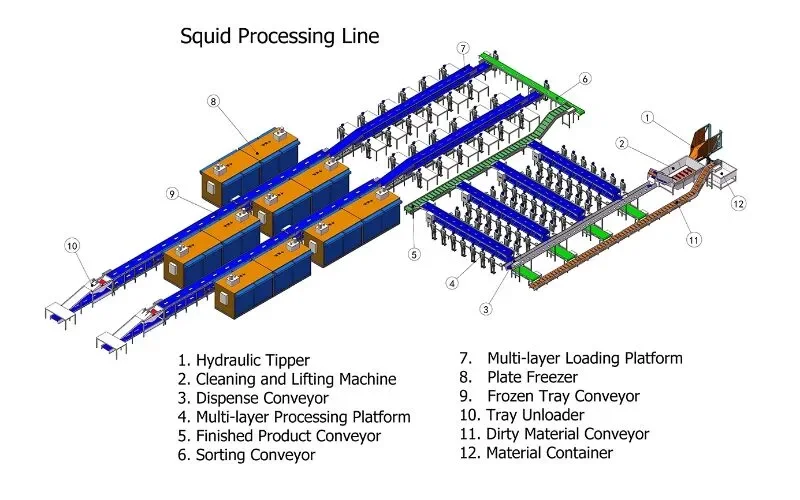
Processing brings heat into the system through motors, conveyors, washing water, lights, workers, and product movement. In the squid processing line shown in MOON-TECH’s seafood material, the line may include tipping, cleaning, lifting, conveying, sorting, tray unloading, and finished product conveying. Each part adds a small load, and together they are not small.
This is why the chiller type should be chosen together with line design. If you only size the compressor from cold room data, the real line may feel underpowered during peak work.
Finished Product Holding Demand
After processing, the finished product needs steady holding before packing, freezing, or shipping. This load is more stable than receiving, but it still matters because long holding time can eat power all day. The chiller should keep the target temperature without repeated start-stop cycles.
MOON-TECH screw compressor systems include automatic control, operation data collection, alarm storage, trend display, and remote communication through Modbus RTU/RS485. These functions are not fancy decoration. They help the plant manager find why the power bill changed this month.
Screw Chiller Type Selection
The word “screw chiller” covers several choices. The better choice depends on your evaporation temperature, process load, refrigerant plan, space, maintenance level, and future expansion. MOON-TECH’s screw refrigeration compressor series includes single-stage screw units, compound two-stage screw units, and skid-mounted separate two-stage screw units.
Single-Stage Screw Chiller
A single-stage screw chiller is a practical choice for medium-temperature seafood processes, chilled processing rooms, and systems where the temperature lift is not too large. MOON-TECH single-stage screw refrigeration compressor units cover a displacement range from 285 m³/h to 14,000 m³/h and can work under high, medium, and low temperature conditions.
This type is usually easier to run and easier to maintain. It can use working media such as R717, R507A, and R404A, depending on the project standard and local rule. For many seafood processing plants, single-stage units are a good base choice when the process does not require deep low-temperature operation all the time.
Compound Two-Stage Screw Chiller
A compound two-stage screw chiller is better when the evaporating temperature is below minus 25°C. MOON-TECH’s technical data notes that this type is more efficient than a single-stage compressor unit with an economizer under low-temperature working conditions. That point is important for seafood plants with heavy freezing demand.
When the system must pull heat from low-temperature zones every day, two-stage compression can reduce wasted work. It is not always the cheapest purchase at the start, but it may be the better energy choice after a few seasons.
Screw Chiller Selection Table
| Screw Chiller Type | Better Fit | Energy Cost Logic | Buyer Note |
|---|---|---|---|
| Single-Stage Screw Chiller | Medium-temperature processing and general chilling | Simple system, steady running, good for balanced load | Good starting point for many seafood lines |
| Compound Two-Stage Screw Chiller | Low-temperature freezing below minus 25°C | Higher efficiency under deep low-temperature conditions | Best when freezing load is heavy and frequent |
| Skid-Mounted Separate Two-Stage Screw Chiller | Larger lines with changing low-temperature demand | Ratio can be matched by condition, easier site delivery | Useful when layout and expansion need flexibility |
Energy-Saving Control Strategy
After the chiller type is chosen, the next cost factor is control. A strong compressor can still waste power if it runs in a rough control mode. For seafood processing, the best system should follow load changes without shaking the temperature up and down.
10% to 100% Load Regulation
MOON-TECH screw compressor units can regulate energy across 10% to 100%. This is useful when the line runs in different shifts or when production volume changes by season. Instead of forcing the compressor to run near full output, the system can match the real demand more closely.
For buyers, this often means fewer useless kilowatt-hours during partial production. It also helps reduce stress on the unit.
Variable Frequency Part-Load Operation
During part-load operation, MOON-TECH units can use frequency conversion and automatic internal volume ratio adjustment according to operating conditions. In plain language, the unit does not have to run like an old fixed-speed machine.
This is especially useful for seafood plants where the line may not work at the same speed all day. The system follows the load, and the operator does not need to keep guessing.
Automatic Monitoring and Alarm Protection
MOON-TECH control systems include early warning, over-limit alarm, shutdown protection, PID energy adjustment, data collection, graph trend display, historical alarm query, color LCD touch screen, Chinese and English interface options, and remote monitoring interface. Some buyers ignore this part during purchase talks, then later pay for it through downtime.
A seafood line is wet, busy, and not always gentle to equipment. Good protection is not optional. It is part of the energy bill and part of product safety.
Cost and Service Planning
A chiller purchase should not stop at the compressor price. You need to count electricity, installation, pipework, controls, maintenance, staff skill, spare parts, and future changes. MOON-TECH’s role as a system provider is helpful here because the company covers both equipment and project support.
Whole-Process Cost Items
| Cost Item | What to Check | Why It Affects Energy Efficiency Ratio |
|---|---|---|
| Cooling Load | Product temperature, line speed, storage time | Wrong load data causes oversizing or undersizing |
| Chiller Type | Single-stage or two-stage screw system | Different temperature levels need different compression plans |
| Control System | Part-load control, alarms, data records | Better control cuts waste during uneven production |
| Installation | Pipe length, insulation, water flow, access space | Bad installation turns good equipment into average equipment |
| Service Plan | Training, maintenance, diagnosis, upgrade | Stable operation keeps energy use from drifting upward |
Industrial Case Data
In one industrial heat recovery project using oil-injected twin-screw compressor units, the system provided 23.4 MW total cooling capacity and 27.4 MW total heating capacity. After the process change, the project saved more than 40 million RMB per year and cut carbon emissions by 79,530 tons per year.
This is not a seafood project, and the process is different, but the lesson is still useful. When screw equipment is matched with the process instead of being bought as a separate machine, energy savings can become very visible. For seafood processing, the same thinking applies to cooling load, freezing demand, and waste heat use.
Full-Process Consultation
A project should start with clear questions. What product will be processed? What is the daily tonnage? What inlet temperature is common? How many shifts will run? Will the factory expand? What power price applies at day and night? MOON-TECH’s full-process consultation can help connect these questions before the equipment list is fixed.
The whole industry chain support also matters when the buyer wants fewer handover risks. One supplier for design thinking, equipment matching, installation support, and service is usually easier than five separate parties blaming each other later.
Start Your Screw Chiller Project with MOON-TECH
If you want the best energy efficiency ratio for a seafood processing line, do not start with the lowest chiller price. Start with the process. Then match the chiller type, control mode, line layout, and service plan. That is the safer way to reduce long-term cost.
Service Support for Daily Operation
MOON-TECH provides service support covering project planning, technical consulting, engineering design, complete equipment, installation and commissioning, staff training, system maintenance, system diagnosis and upgrade, and contract energy management. For seafood factories, this is useful because your cost problem may appear months after start-up, not only during installation week.
Project Reference Review
Before final selection, you can review the company’s project experience to see how system thinking is used across different industrial cooling and energy projects. The names do not matter here. What matters is whether the supplier can handle real operating pressure, tight schedules, and long-term service.
Custom Solution Request
For a seafood line, the right screw chiller type may be single-stage, compound two-stage, or skid-mounted separate two-stage. The answer depends on your real temperature target and production rhythm. The next step is to share your process data through contact MOON-TECH and ask for a matched solution, not just a machine quote.
FAQ
Q1: Which Screw Chiller Type Usually Has the Best Energy Efficiency Ratio for Seafood Processing?
A1: The best type depends on the working temperature. A single-stage screw chiller can suit medium-temperature processing, while a compound two-stage screw chiller is often better for low-temperature freezing below minus 25°C.
Q2: Why Is Part-Load Control Important for Seafood Factories?
A2: Seafood lines often run with changing loads during receiving, sorting, processing, and holding. Part-load control helps the compressor match real demand instead of wasting power at low production volume.
Q3: Can a Screw Chiller Reduce Cost without Changing the Whole Processing Line?
A3: Yes, but the result depends on the existing layout, pipe system, controls, and temperature zones. A system diagnosis can show whether the chiller, control logic, or line arrangement is the main problem.
Q4: Why Should You Consider MOON-TECH for a Seafood Processing Cooling Project?
A4: MOON-TECH combines screw refrigeration compressor units, seafood processing solutions, project design, equipment supply, installation support, training, maintenance, and system upgrade service.
Q5: What Data Should You Prepare Before Asking for a Screw Chiller Quote?
A5: You should prepare product type, daily capacity, inlet temperature, target temperature, processing hours, freezing demand, power supply, site layout, and any future expansion plan.