
An inquiry may arrive with one bold line: ‘1,000 kg/h IQF freezer.’ My note beside it is usually just, ‘Product?’ One tonne per hour of beans tells me almost nothing about a later run of berries, glazed shrimp or cut fish. They bring different water loads, temperatures and belt behavior. Until those details are attached, the big hourly number is only a heading.
This is where many freezer quotations become difficult to compare. One bidder uses a small, loose vegetable at +15°C inlet temperature. Another quotes the buyer’s heavier product after precooling. The kg/h numbers may look close while the heat load and airflow resistance are not close at all.
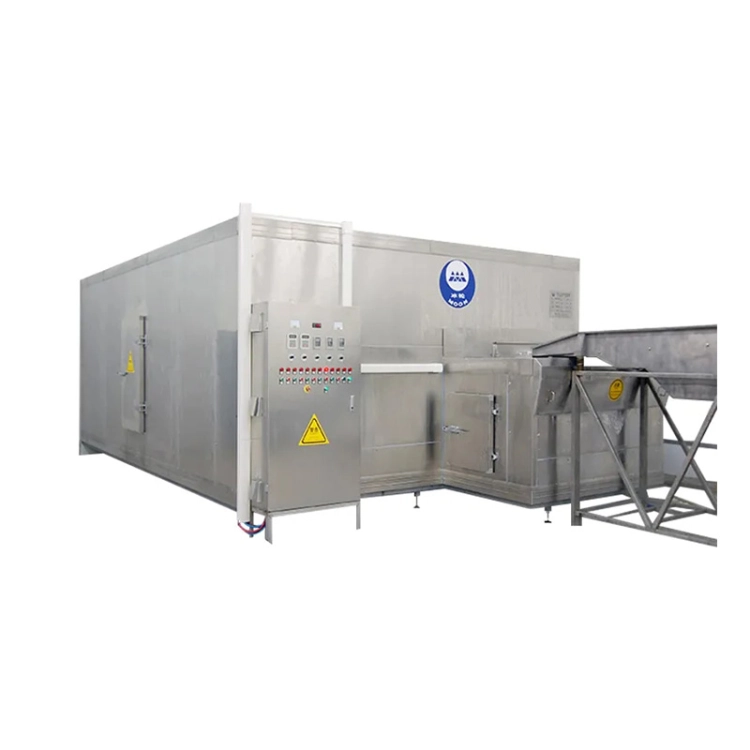
MOON-TECH groups fluidized, tunnel, spiral and plate systems under its Quick Freezer e Freeze Dryer range. Each type has a different way of carrying product and moving cold air, so capacity has to be tied to the actual application.
Nameplate Capacity Is Based on a Defined Test Product
A proper capacity statement includes the product, piece size or weight, water content where relevant, inlet core temperature, required outlet core temperature and freezer air temperature. Belt loading and residence time belong in the same note. Remove those details and the number cannot be transferred safely to another product.
MOON-TECH data for the MVD fluidized freezer use green sword beans as the nominal basis, with about 70% water, a stated bulk density of about 900 kg/m³, product entering at +15°C, leaving at a core temperature of -18°C and a freezing temperature of -35°C. That is a clear reference case. It does not mean every product will reach the same kg/h on the same machine.
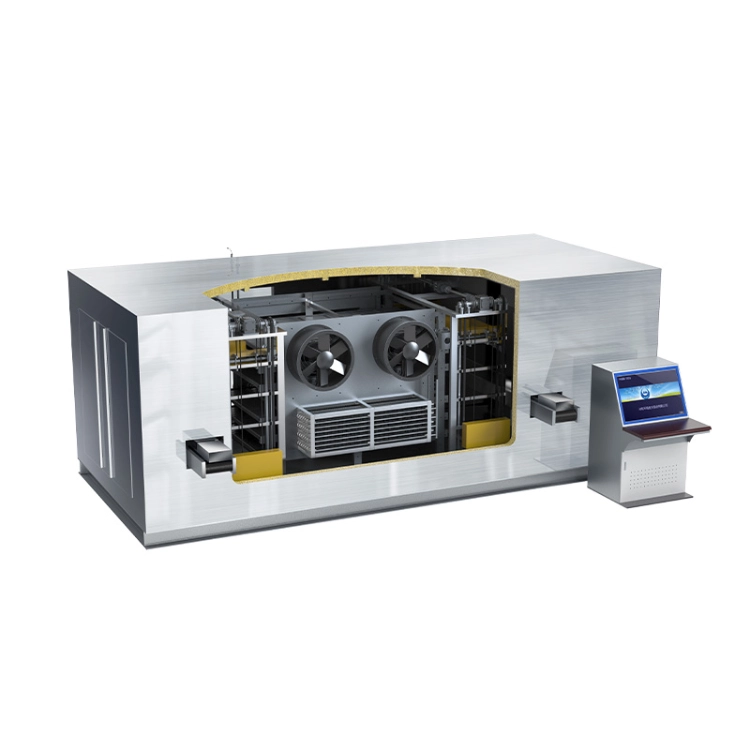
O MOON-TECH Fluidized Quick Freezer is arranged in two stages. Product first gets a surface freeze, with mechanical vibration used to discourage pieces from joining together. The remaining pull-down toward the required core condition happens in the following stage.
The Same Freezer Can Show Different kg/h Figures
The MVD1000 comparison in the supplied product material makes the point plainly. Under the stated +15°C inlet, -18°C outlet core and -35°C freezing condition, green sword beans are listed at about 1,000 kg/h. Sweet corn is about 600 kg/h. Strawberries are about 800 kg/h. The freezer has not changed. The product load has.
The MJN750 table is even easier to read as a set of separate jobs. Raw shrimp of about 15 g are shown at roughly 660 kg/h with -35°C air. The same shrimp case moves to 750 kg/h at -40°C and 790 kg/h at -42°C. Keep the air at -40°C but change the food: 110–130 g cod slices are around 410 kg/h, while 60 g hamburger steaks are around 1,100 kg/h. Product and condition must stay beside every figure.
Why the Product Changes the Freezing Load
Water Content and Initial Temperature
A large share of the duty is simply the heat that must leave the food, including the latent heat when its water freezes. More water usually means more work per kilogram. Entry temperature can move the answer just as much. Product fed at +5°C after a precooler is a different case from the same product arriving at +20°C from the preparation room.
The word ‘frozen’ is too loose for an outlet guarantee. Put a core temperature on the sheet and say where the probe goes. Thin food can feel hard outside while its centre has not reached the agreed point. If the cold store expects a -18°C core, that is the number the selection and test must follow.
The Pieces Do Not Meet the Air in the Same Way
Air can get around a small loose piece much more readily than around a thick block. Cod lies flat, strawberries roll, and glaze changes the shrimp surface. Lay any of them on top of one another and the route for air changes, even though the belt scale still shows the same kilograms per metre.
Do not stop at average weight. A shrimp line may be mostly 15 g pieces and still send enough larger ones to affect the result. Show the normal size spread. If every outlet sample has to pass, residence time will often be governed by the larger regular pieces, not the average one.
How the Product Sits on the Belt
Hourly output is made on the belt: how much sits there and how quickly it travels. A deeper layer adds weight, yet it can also make the fan fight through the bed and ruin the fluidized action. Very light food runs out of belt area first. I therefore ask for kg/m², actual bed depth and feed distribution alongside the target kg/h.
The upstream feeder can undo a good freezer setting. If it drops a heap on the left and leaves the right side bare, one lane gets easy air and the other struggles. An average outlet reading can hide that warm lane, so distribution needs to be checked across the belt.
A Low Air-Temperature Reading Is Only One Clue
The MJN750 shrimp figures rise as air moves from -35°C to -40°C and then -42°C, which is reasonable: there is more temperature difference to work with. Even so, I would not judge the run by that sensor alone. Fan flow, velocity, available pressure, coil condition and the resistance of the food bed determine whether the cold reaches the middle of the belt.
A clean coil at the start of a test is the easy case. As frost builds, airflow changes. Door openings, moisture coming off warm food and recovery after cleaning add their own effects. I ask whether the quoted capacity is a clean-coil snapshot, an average between defrosts, or a line guarantee over a written cycle.
The product information gives variable fin spacing of 40–20–10 mm. It also lists frequency control for fan, conveyor and vibration. Operators can use those controls as the load and frost pattern move, but corn still will not behave like berries or beans.
Which Freezer Route Fits the Food?
A fluidized arrangement suits many small, loose products where separation matters. The first stage sets the surface and vibration reduces sticking; deeper freezing follows in the second stage. Beans, corn and similar pieces are typical discussions. The actual suitability still depends on size, surface moisture and whether the product can be moved without damage.
O MOON-TECH Intelligent Tunnel Quick Freezer is a different choice for products carried through a controlled tunnel. Its published MJN examples cover shrimp, cod slices and hamburger steaks, showing why tunnel selection also starts with the product rather than a generic capacity label.
It is unusual for one recipe to cover every SKU well. A vegetable line that switches to delicate seafood for a short season may need changed fan and belt settings, a different feeder, or a separate mechanical route. Put the yearly production calendar on the table before sizing around one peak hour.
What to Put in an IQF Freezer RFQ
A useful request for quotation can fit on a few pages if the product cases are honest. Give one table for each important SKU rather than mixing them into a single ‘average product.’
- Identify the food and its formulation; note whether it arrives raw, cooked, blanched, glazed or coated.
- Give the small, typical and large piece weights or dimensions. Add photos when the shape is hard to describe.
- Water content or composition data available from the process team.
- Minimum and maximum inlet core temperature at the freezer feed point.
- Required outlet core temperature, measurement location and acceptable tolerance.
- Required kg/h for each SKU, plus daily operating hours and seasonal production pattern.
- Expected belt loading, bed depth, bulk density and the type of upstream spreader or feeder.
- Freezing-air design temperature, refrigerant, defrost plan and available refrigeration duty.
- Cleaning method, sanitation window, drainage requirement and permitted changeover time.
- Acceptance-test product, test duration, sampling plan and treatment of out-of-range pieces.
Agree on the Performance Test Before Ordering
Before the order, name the product that will be used for acceptance and write down the test condition. During the run, record inlet temperature, size range, feed rate, belt speed, air condition, defrost status and the core readings. Taking only the easy pieces from the belt edge makes a nice report and a bad baseline.
If the plant needs several products, set a guaranteed case and additional reference cases. The supplier can then explain which changes require belt-speed adjustment, fan frequency, vibration setting or a different loading depth. This is more useful than asking for one capacity guarantee to cover every future SKU.
For plants handling produce, MOON-TECH’s discussion of an integrated precooling and cold storage solution is relevant to the conditions before and after IQF freezing. Stable inlet temperature and a clear downstream cold-store plan make the freezer duty easier to define.
Conclusão
I treat every IQF capacity as a sentence with conditions attached. Change the food, its size, entry temperature, core target, bed or airflow resistance, and the hourly number moves. Quotations become comparable only when bidders calculate the same SKU cases. At commissioning, use that named SKU and an agreed sampling method; otherwise the nameplate figure remains just a sales-line number.
FAQ
Q1: Why can one IQF freezer have several capacity figures?
Because each figure may use a different product, piece size, inlet temperature, outlet core target or freezing-air temperature. Capacity is valid only with its stated test basis.
Q2: What is the nominal basis for the MOON-TECH MVD fluidized freezer?
The supplied material uses green sword beans, about 70% water and roughly 900 kg/m³ bulk density, with product entering at +15°C, leaving at -18°C core temperature and freezing air at -35°C.
Q3: Does colder freezing air always increase output?
It can increase the heat-transfer driving force, but output also depends on air volume, pressure, coil frost, product-bed resistance, belt loading and the required core temperature. Air temperature alone cannot guarantee capacity.
Q4: Which product data are most important for an IQF freezer quotation?
Provide product type, piece-size range, water content if known, inlet and outlet core temperatures, required kg/h, bulk density, bed depth, feed distribution and the sanitation and defrost cycle.
Q5: How should a factory test IQF freezer capacity?
Run the agreed SKU in its stated size range. Log the inlet condition, feed rate, belt speed, air reading and defrost state, then take core samples from the left, centre and right of the belt. Decide the pass rule in writing before the test starts.