
Hot weather exposes design and control choices that may go unnoticed in spring. In a transcritical CO2 plant, the gas cooler has less room to reject heat as the outdoor temperature climbs. Pressure, power use, and room pull-down time may then move in the wrong direction together, especially when the original selection relied on mild-weather data.
CO2 can operate in a warm climate, so that is not the difficult part of the decision. The harder question is whether the gas cooler, high-pressure valve, compressor sequence, heat-recovery circuit, and sensors suit the weather and load that the plant actually sees. The checks below help a buyer separate a summer control problem from a genuine equipment limit.
МУНА-ТЕХ has been developing refrigeration and energy solutions since 1956. Its experience covers system integration, equipment selection, commissioning, operating-data review, and lifecycle support for projects in more than 120 countries and regions.
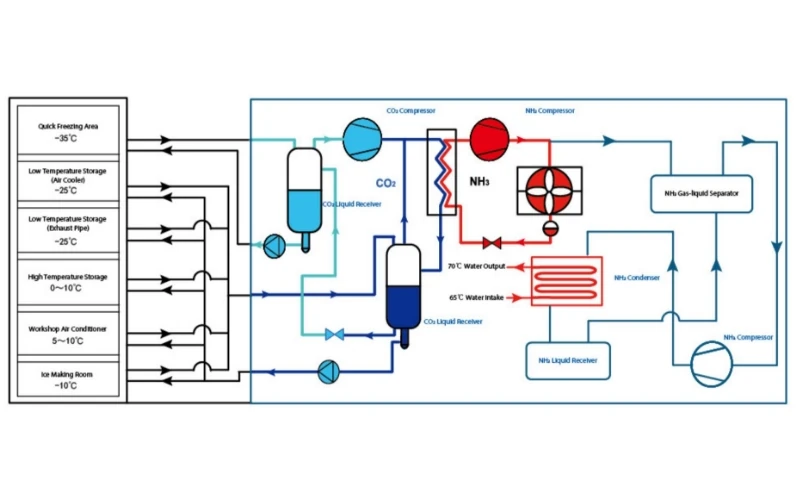
How Does Ambient Temperature Change the Transcritical Cycle?
During transcritical operation, heat rejection takes place above the CO2 critical point. That changes the operator’s reference point: the gas cooler is not simply a conventional condenser with a different refrigerant. As weather and load shift, the most efficient high-side pressure also shifts, and the compressor must respond without losing room-temperature control.
Gas Cooler Performance and Outlet Temperature
Gas cooler performance depends on ambient temperature, airflow, coil condition, refrigerant control, and the temperature approach available for heat rejection. Start with the gas cooler outlet temperature, but read it beside the ambient value and fan status. A gradual rise on a hot afternoon may be normal. A larger gap than the clean baseline points elsewhere: dirt on the coil, weak airflow, hot-air recirculation, a failed fan, or too little surface for the duty.
High-Side Pressure Control
There is no useful single pressure target for every hour of the year. The preferred value depends on outlet temperature, load, the compressors that are running, and the valve strategy. Put high-side pressure, compressor kW, gas cooler outlet temperature, and room recovery on one trend. A pressure reading by itself says little about efficiency.
Warm-Weather Efficiency
Summer losses usually show up as a sequence rather than one alarm. The day gets hotter, pressure rises, another compressor stays on longer, and rooms take more time to recover after a peak. One afternoon can mislead; several comparable days make it easier to tell normal weather response from an airflow, sensor, control, fouling, or capacity fault. Comparing these variables together is more useful than treating any single reading as proof of a system fault.
What Should You Check Before Summer?
Do this review before the first design-temperature week, not during it. Walk around the equipment, then compare what you saw with recent trends and maintenance dates.
Airflow and Coil Condition
Stand where the gas cooler draws air and look for changes around it. New walls, screens, stored materials, damaged guards, the wrong fan direction, or a slow fan can send hot discharge air back through a clean coil. Cleaning alone will not correct that airflow path.
Control Response Under Peak Load
Watch a period when production and weather peak at the same time. Note whether the high-pressure valve settles, whether compressor stages hold long enough to be useful, and whether room temperature recovers smoothly. Fast hunting can come from a bad sensor, narrow control bands, or a staging order that does not fit the available capacity steps.
Hot-Weather Operating Diagnostic Table
Compare these indicators during similar load periods rather than judging system efficiency from a single pressure reading. The table below shows which operating trends are expected in hot weather and which changes may point to airflow, control, sensor, or capacity problems.
| Проверить товар | What to Compare | Expected Hot-Weather Trend | Warning Sign | Что проверить |
| Ambient Temperature | Compare similar production-load periods | Rises during hotter outdoor conditions | Extreme temperature repeatedly coincides with performance loss | Confirm whether conditions exceed the original design basis |
| Gas Cooler Outlet Temperature | Compare with ambient temperature and the clean baseline | Normally rises as ambient temperature rises | Temperature gap becomes noticeably larger than the clean baseline | Coil fouling, weak airflow, hot-air recirculation, failed fan, or insufficient heat-transfer surface |
| High-Side Pressure | Compare with gas cooler outlet temperature and system load | Adjusts upward as operating conditions require | Pressure remains unnecessarily high or fluctuates rapidly | High-pressure valve, sensor accuracy, control bands, and pressure strategy |
| Compressor Power | Compare during similar refrigeration loads | May increase during hotter conditions | Power rises significantly while cooling performance worsens | Excessive high-side pressure, poor staging, or heat-rejection problems |
| Compressor Staging | Compare compressor status during similar loads | Additional capacity may remain online longer | Frequent starts, short cycling, or rapid stage changes | Capacity-step sizing, control sequence, and part-load strategy |
| Room Recovery Time | Compare after similar load peaks | May become longer as outdoor conditions become more demanding | Recovery becomes progressively slower across comparable days | Available capacity, airflow, controls, and gas cooler performance |
Which Controls Stabilize High-Side Pressure?
The best control strategy follows both weather and load. It should prevent unnecessary pressure while maintaining enough capacity for process cooling, cold rooms, and freezing demand.
Floating High-Pressure Setpoint
A floating setpoint adjusts high-side pressure according to gas cooler outlet conditions instead of holding an unnecessarily high fixed value. The control must still respect equipment limits and stable valve operation. Trend review should confirm that the pressure moves smoothly and that room temperatures remain stable.
Compressor Staging at Part Load
Factories spend many hours below peak load. Poor staging can cause short cycling, excessive starts, unstable suction pressure, and inefficient operation. Capacity steps should match the smallest normal load as well as the design peak. Variable control can help, but it must be coordinated with oil management and system pressure.
Adiabatic Assistance and Water Use
Adiabatic assistance can lower incoming air temperature during hot periods, but it adds water-quality, maintenance, and hygiene responsibilities. Buyers should compare annual hot-hour frequency, water availability, treatment requirements, and expected energy benefit before adding the feature. It should solve a measured heat-rejection problem, not hide poor base design.
Heat Recovery Without Destabilizing Cooling
CO2 systems can provide useful heat, but heat recovery should not force the refrigeration side to operate at excessive pressure when there is no valuable heat demand.
Matching Heat Demand and Cooling Load
Map hot-water or process-heat demand by hour and season. Then compare it with refrigeration load. A plant with simultaneous cooling and hot-water demand may use recovered heat consistently. A seasonal or intermittent heat user needs storage, backup heat, or a control method that allows cooling efficiency to take priority.
Priority and Bypass Logic
The control sequence should define when heat recovery is enabled, when temperature is satisfied, and when heat must bypass the recovery exchanger. Operators need clear alarms for low flow, high temperature, and abnormal pressure. This prevents a useful energy feature from becoming a source of unstable refrigeration operation.
Measurable Heat-Recovery Value
Measure recovered heat from flow and temperature difference rather than estimating value from compressor run time. Compare the useful heat delivered with additional pump power, water treatment, maintenance, and any change in high-side pressure. This gives a realistic operating benefit.
Project Review and Upgrade Decisions
Before changing equipment, establish whether the main limitation is climate selection, heat-transfer condition, controls, compressor capacity, or the building load itself.
Data Required for a Technical Review
Collect hourly ambient temperature, gas cooler outlet temperature, suction and high-side pressure, compressor status, power use, valve position, room temperatures, defrost events, and production schedule. Include alarm history and maintenance dates. These records turn a general complaint about summer performance into an engineering question.
Solution Configuration
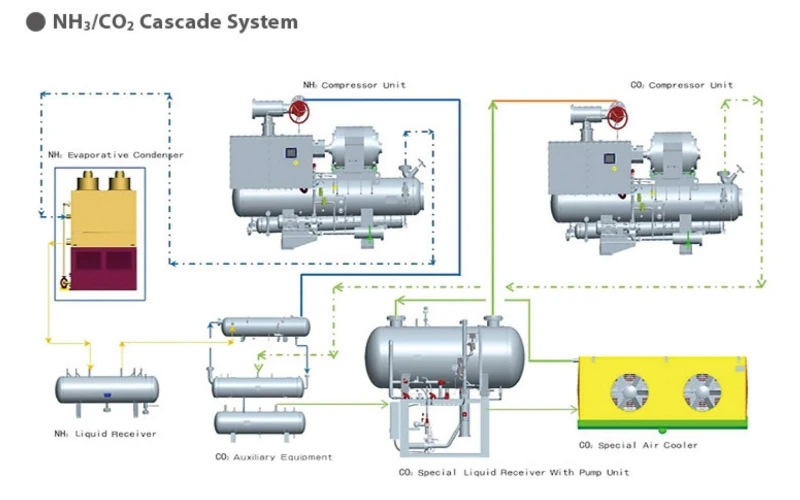
For food processing, logistics, industrial ice, or process cooling, a CO2 refrigeration system solution still begins with local weather and the plant’s real load pattern. Service access and future capacity matter as well. Gas cooler selection, compressor combinations, valves, and heat recovery must work as one sequence; pushing one pressure setting higher is not a system plan.
Lifecycle Support
A control change should be documented, tested at partial and peak load, and reviewed after seasonal conditions change. CO2 refrigeration project consultation can connect early load review with equipment and control decisions, while industrial refrigeration lifecycle support helps maintain sensors, alarms, heat-transfer surfaces, and operating records. For projects spanning design through commissioning, integrated project delivery provides a broader coordination path.
Вывод
When summer performance slips, avoid starting with a higher pressure setting or a larger compressor. First line up the weather, gas cooler outlet temperature, pressure, power, stage status, and room recovery time. Stable high-side pressure control depends on gas cooler performance, compressor staging, valve response, and reliable operating data. That evidence shows whether the plant needs cleaning, airflow work, sensor correction, control changes, or more heat-rejection capacity. A transcritical CO2 refrigeration system performs best when both its hot-day peak and its ordinary part-load hours were considered from the start.
Часто задаваемые вопросы
Why does high-side pressure rise in warm weather?
The gas cooler has less temperature difference available for heat rejection, so the system may need a higher operating pressure to maintain capacity.
Does high pressure always mean the gas cooler is undersized?
No. Check ambient temperature, coil cleanliness, airflow, sensor accuracy, valve control, and load before deciding that surface area is insufficient.
What data best explains summer efficiency loss?
Compare ambient and gas cooler outlet temperatures, high-side and suction pressures, compressor power, stage status, and room recovery time.
When is adiabatic assistance worth considering?
It is most useful when hot-hour data shows a repeated heat-rejection limit and water quality, maintenance, and operating cost are acceptable.
Can heat recovery increase CO2 system energy use?
Yes. If the controls maintain excessive pressure after useful heat demand is satisfied, compressor energy can rise without a matching benefit.